Explore the House
Enjoy a house steeped in history, built by Robert Cecil, in the grounds where Queen Elizabeth I spent much of her childhood.
The King James Drawing Room
This room takes its name from the life-size statue of James I, presented by the King himself, which stands above the mantelpiece. It is made from stone, painted to look like bronze. The marble chimneypiece was carved by the King’s Master Sculptor, Maximilian Colt (d.1649).
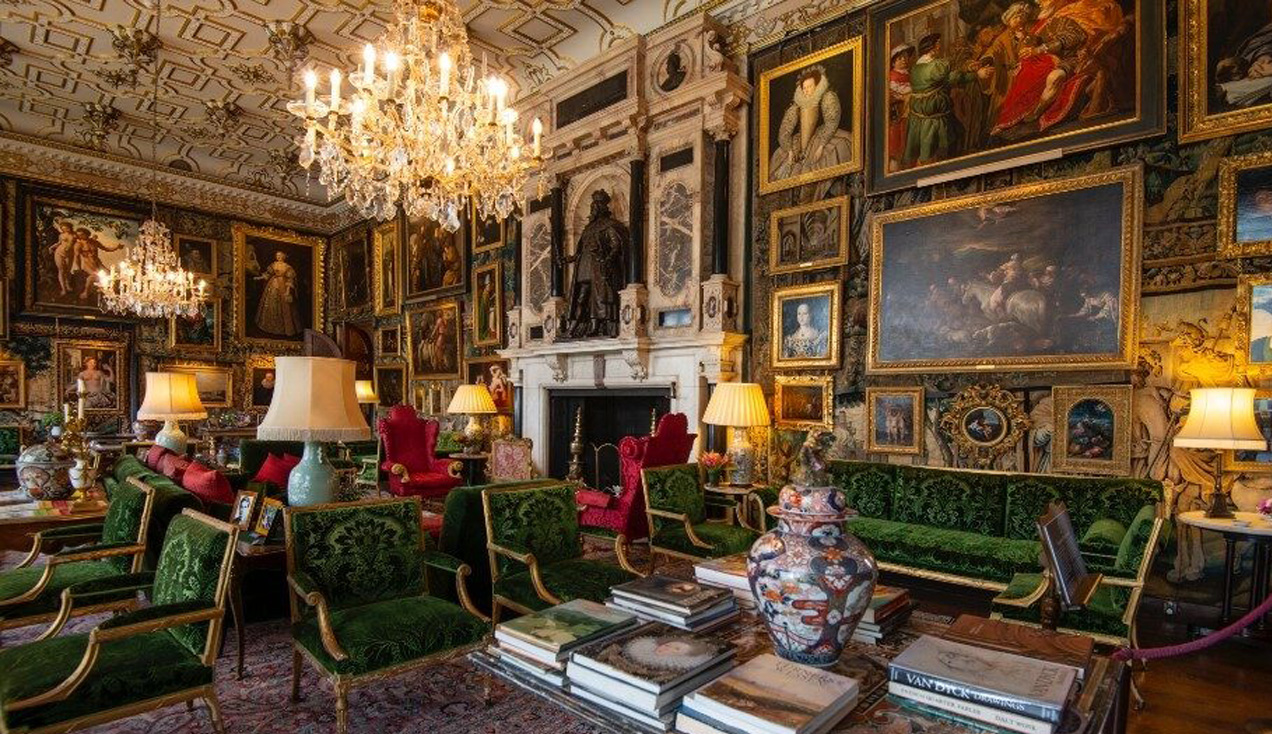
The King James Drawing Room
When King James I visited Hatfield in 1611, the room was hung with six tapestries telling the story of Hannibal and Scipio. Today’s visitors can see more recently acquired tapestries that have been installed as a background to the many splendid pictures, one of which is the famous Ermine portrait of Queen Elizabeth I. Displayed in the centre of the north wall of the room, this is one of the four paintings of the monarch which were owned by Robert Cecil at the beginning of the 17th century. Gold is used liberally in the painting on her necklaces, jewellery and the Sword of State lying by her left hand. The date of the portrait (1585) is inscribed on the hilt.
Elizabeth holds a sprig of olive in one hand (representing Peace) and has a small white animal on the sleeve of her left hand. The animal is an ermine, a symbol of purity and virginity: it wears a collar in the form of a golden crown around its neck, decorated with precious stones.
The portrait is possibly connected with the Queen’s 1585 visit to William Cecil, Lord Burghley, at Theobalds. The royal features are impassive and painted in a flat light that makes the Queen look aloof and imperious. The detail on the jewellery and lace is particularly magnificent, whilst the pendant hanging from her neck is set with three huge rubies that once belonged to the Dukes of Burgundy and were known as the Three Brothers. The Queen’s monument in Westminster Abbey shows her wearing this jewel.
Most of the furniture is of the late 18th century, but the desk in the central window bay is much more recent. It was commissioned by the present Marquess of Salisbury from Mr Rupert Brown in 2005. Known as the Chase Desk, it features a continuous scheme of marquetry depicting a boar hunt that might have taken place at Cranborne, Dorset, in 1610, soon after Robert Cecil had acquired the property.
DISCOVER
Explore nearby